Introduction to Operating Systems
- operating system作为software interface连接computer user and hardware
operating system的功能
- memory management
- processor management
- device management
- file management
- network management
- security
- control over system performance
- job accouting
- error detecting aids
- corrdination between other software and users
Instructions and Addressing Modes
- 程序由CPU可以理解的sequence of instructions组成
- 这些instructions从memory中取出并逐步运行
Basic Computer Operation Cycle
Type of instructions
- Data Movement Instructions(数据传送指令):在register,memory and I/O device之间移动数据, 如MOV.PUSH,POP,IN,OUT等
- Program Control Instructions(程序控制指令): 改变程序的执行顺序, 如JMP,JZ,JNZ,…,CALL,RET,INT,IRET等
- Arithmetic and Logic Instructions(算术与逻辑指令): 执行计算或者位运算, 如ADD,INC,SUB,DEC,MUL,DIV,AND,NET
- etc.
Instruction Cycle
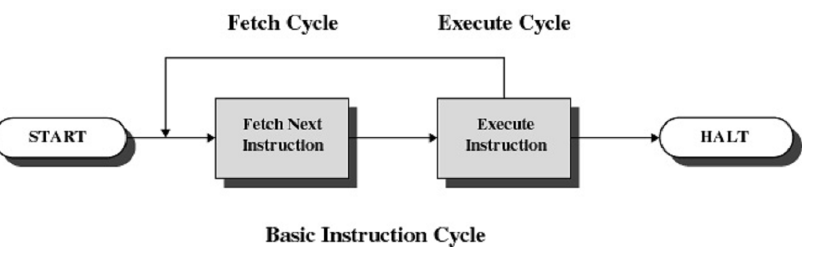
- 简单的Instruction Cycle过程如下:
- 具体的一次完整的Instruction Cycle的过程如下:
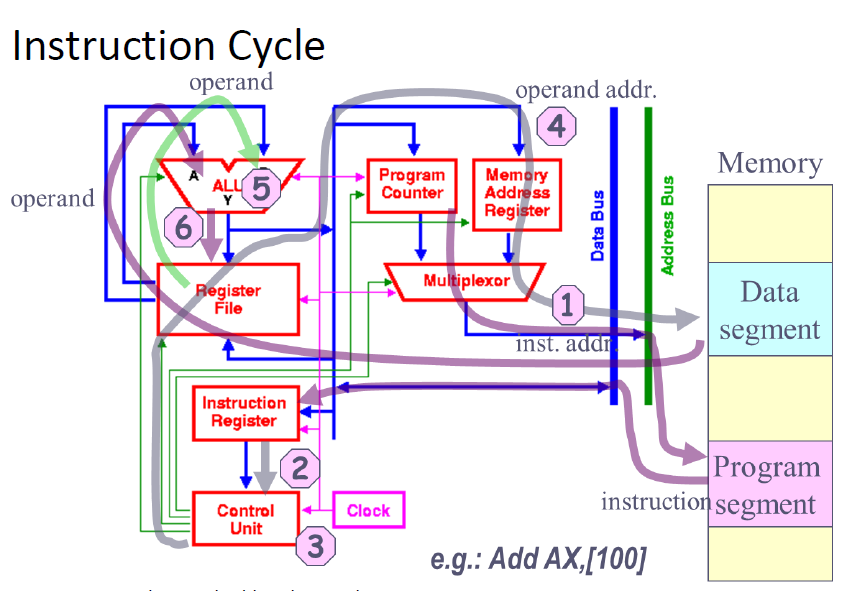
- Fetch Instruction: PC → Multiplexer → Address Bus → Program segment → Data Bus → IR, 通过PC/IP地址从内存中取指并存入Instruction Register(IR)中
- Decode the instruction: IR → Control Unit, 拆分指令的结构并分析指令含义
- Locate the operands: 在Clock控制下Control Unit发出控制信号并根据addressing mode确认操作数位置
- Fetch the operands: Operand address → MAR/MUX → Address Bus → Data segment → Data Bus → Register File, 调取数据暂存到CPU的Register File中为运算作准备
- Execute the operation: Register File → ALU inputs → ALU, 两个operands被送到ALU进行运算操作的执行
- Store the result: ALU output Y → Register File, 将结果存入目的地(本例为register file中的AX), 如果 destination 是内存,则结果需要经过 Data Bus 写回 Data segment
- Fetch the next instruction: 重新开始流程